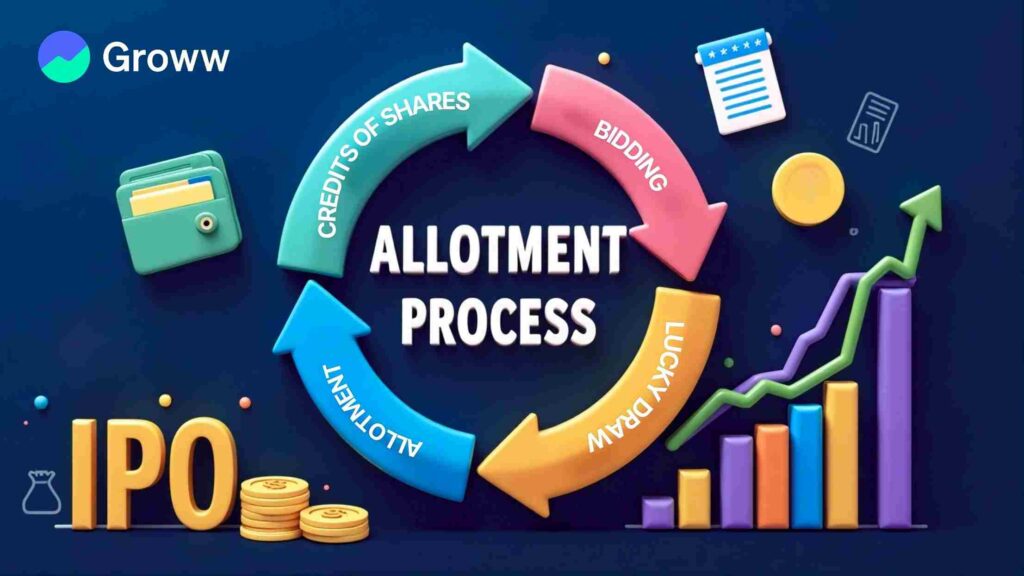

The excitement around a new public offering in India is hard to match. Every time a company launches its initial public offering, thousands of retail investors rush to submit applications, hoping to secure shares. Understanding IPO allotment — how shares are distributed after bidding closes — is something every investor must grasp before applying. Equally important is tracking the IPO subscription status live during the open bidding window, as it helps investors gauge demand and make smarter decisions. This article breaks down the mechanics clearly so you can approach every new listing with confidence.
The Journey from Application to Allotment
When a company decides to go public and opens its subscription window, investors can apply through their Demat accounts using either the ASBA (Application Supported by Blocked Amount) process or UPI-linked platforms. The bidding period usually stays open for three working days, during which funds are not debited but are simply blocked in your bank account. Once the subscription window closes, the registrar begins the complex process of determining who gets shares and how many.
Allotment is not a random lottery in the way many people assume. The Securities and Exchange Board of India has laid down specific rules that govern how shares are distributed across different investor categories — Qualified Institutional Buyers, Non-Institutional Investors, and Retail Individual Investors. Each category receives a fixed proportion of the shares on offer, and any oversubscription within a category is handled through a proportional or lottery-based system, depending on the investor type.
How Retail Allotment Is Decided
For retail investors, the rules are quite investor-friendly. If an issue is subscribed fewer times than the number of applicants, every applicant gets at least one lot. If the issue is oversubscribed, a computerised lottery is conducted among all valid applicants. This means that whether you applied with the minimum bid or the maximum retail limit, your chances of getting one lot in a highly oversubscribed issue are generally equal.
This is why many seasoned investors apply from multiple family members’ accounts — increasing the number of applications raises the probability of at least one successful allotment. However, each application must come from a unique PAN card. Submitting multiple applications from the same PAN leads to rejection of all applications under that PAN.
The Role of the Registrar
Every exchange has a nominated registrar — groups like KFintech and Link Intime India are a few of the commonly appointed ones. The registrar collects all the applications, validates them, evaluates them for breeding pans and then runs the allocation technique. Invalid applications, those with incorrect UPI system rejection or bank account discrepancies, will be filtered out before the final draw.
Once the allotment is complete, the shares will be credited to the Demat accounts of the hit candidates on the exact date of allotment. Quantities blocked for unsuccessful applicants will be blocked or refunded within the specified operating days.
Why Oversubscription Numbers Matter
When an issue receives overwhelming demand, the oversubscription figures tell you a lot. An issue subscribed to fifty times in the retail category means your odds of getting an allotment through lottery are quite low if you have a single application. On the other hand, an issue barely subscribed to at one time in retail leaves every applicant with shares.
Following the subscription data closely during the open window allows you to decide whether to bid at the cut-off price or exit if you feel the valuation seems stretched, given extreme demand. It also helps you anticipate listing price trends since institutional and HNI demand often signals market sentiment quite clearly.
After Allotment — What Comes Next
Once shares are credited to your Demat account, you have two choices: sell on listing day or hold for the medium to long term. The right choice depends entirely on your investment thesis. If you applied purely for listing gains and the grey market premium is intact, booking profits early may be sensible. If the company’s fundamentals are strong, holding through short-term volatility could generate better returns.
Tax implications are also important. Shares sold within twelve months of listing attract short-term capital gains tax at fifteen per cent, while those held longer benefit from the long-term capital gains rate of ten per cent on gains above one lakh rupees.
Building a Disciplined IPO Strategy
Rather than applying to every issue that comes along, focus on companies with clear growth stories, strong promoter credentials, and reasonable valuations. Read the Red Herring Prospectus — it contains everything from risk factors to financial statements. The GMP or grey market premium can give you an unofficial pulse of expected listing performance, though it carries no guarantees.
A disciplined approach, consistent tracking of allotment outcomes, and a genuine understanding of business fundamentals will serve you far better than simply chasing every listing.